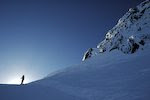
We climbed ten thousand feet in less than forty eight hours, camping twice along the way. Five minutes before sunrise, Darlene and I gained the summit and Marco joined us as the sun rose over Mount Kilimanjaro in the distance. We were the first to summit that day just ahead of a massive group of Slovenians, who just missed the sunrise but immediately commandeered the tiny peak, ill-tempered.
Upon touchdown in Tanzania three months prior, we really believed we would climb Kilimanjaro, bag Africa’s highest peak, bask in the bragging rights and, coupled with the Serengeti, we’d do Tanzania right. We did do Serengeti, though we kinda went in the backdoor. But we never thought we’d be on the summit of the other mountain, staring across at the snows in Hemingway’s yarns.
Then again, nothing in Tanzania went the way we expected. And it was all for the best.
 After three months in Tanzania we’d learned that the more you planned, the less you saw. Preconceived notions will prove you a fool and only by walking slowly with eyes wide open do you start to really see Africa.
Our climb was cheaper, more aesthetic, and less crowded unless you count the giraffe and buffalo. Our traveling companion surprised us with a rare form of HAD, high altitude diarrhea, “guys, I had to use rocks.” Our mandatory armed ranger came down with malaria and had to be evacuated, leaving us to follow the fresh buffalo tracks on our own. These were circumstances out of our control, but our social faux pas came in the process of tipping, an extravagant affair in full documented view of our entire staff, which consisted of a main guide, an assistant guide, six porters, a cook, and our aforementioned armed guard. A ridiculous affair but so full of inexplicable decision making that one can only describe it as consistent.
 Thats Africa. Consistently unexpected, except in expecting the unexpected for all sorts of reasons that we’d never come up with on our own but ultimately boil down to flawed simplicity. And in the end, I smile knowing that no other country I’ve ever visited has challenged my place in the world quite like this east African nation.


 Five minutes into the park we saw a young lioness tearing apart a Buffalo. If you have never seen a grown lioness stretch and flex her massive figure, let me just note they are sculpted power. It left an impression.
 Before crawling into our tents, a herd of six buffalo came grazing behind the banda. Everyone huddled inside until they were gone. The affable mzee, Daudi, explained that yes, as I had heard, there were three lions tracking these buffalo. He imitated a lions call so we would know it. No more then ten minutes later we heard this sound again, but this time he was pointing, hapo, there. If you hear the baboons, he said, imitating their calls, it means they are alarmed by lion. Then he demonstrated the hyenas cry, explaining that hyena follow lion. We started taking in all the sounds, registering them, and realizing that no sound was the best sound. Miraculously, we actually fall asleep.
 I was the first to venture out at the crack of dawn, luring our driver from his car, anxious to get the day started. Duadi pointed out the tracks of a lioness and a hyena that had passed thru our camp. Tracks also clearly showed that we had been smack dab in the middle of where the buffalo roam.
 We took a dalla-dalla to Lake Manyara. A dalla-dalla is any form of vehicle, usually a minivan, into which they can cram about twenty people. That’s the legal number, but as they say in Tanzania, there’s always room for one more. And no, it’s not any different than any other minivan, it’s simply CRAMMED with people, they literally sit atop one another and hang out the sliding door, which is not often closed. But it’s cheap and gets one around. Usually. Actually, ours broke down halfway and after waiting at the side of the road for twenty minutes, we finally crawled into a smaller one and resumed our journey.
 At the lake, we rented mountain bikes to tour the local village, Mto wa Mbu, which is literally translated as Mosquito river. It’s an unfortunate name as the area is beautiful with tribal culture and mosquito free in the heat of the day. We pedaled jeep road and single track thru banana plantations, sampled banana beer and capped it off with a ride thru the wide open grasslands bordering the lake.
 We were surrounded by zebra and curious wildebeest. Gazelles sprinted around us in sport. There are giraffe, but we didn’t see any that day. At one point I stopped riding and watched in awe as four zebra galloped a half circle around me before they made their way off to the lake, which is so full of flamingos, it glows pink. The pool where the river meets the lake is so full of hippos one could not count them all. We kept a respectable distance, but were close enough to watch them emerge and wander the grounds. As a treat to ourselves, we took a bus home, splurging on the extra thousand shilling, or eighty cents. It was a fantastic way to finish up 2009 and we’re giddy with anticipation for 2010.
 I'd taken to riding in the Land Rover with the tanzanian staff. It started on the second day in order to beat the mobile clinic to the village and capture video of it's arrival, but from that moment on I kept my spot in the car. I preferred the intoxicating laughter as the staff amused themselves in rapid fire kiswahili. I didn't understand a lick of it, but Amiri translated bits and entertained me in english as well. I spent the mornings strolling the village before work began, occasionally raising my camera or greeting the locals.
 I've been to some pretty remote spots, but this was exceptional. Roads forged simply by driving the terrain. Tracks led off in multiple directions as we tried to ascertain the paths of least resistance. It was afternoon and I'd been invited to do a home visit for a patient unable to walk the return trip. Turn right at the shrubs here, go thru the break in the fence there, there were six of us, including two men that weren't among the one hundred selected for treatment that day. Their knowledge was our map and on the return, they wanted to take me to maji moto, a small bubbling natural hot spring in the middle of a vast flat salt plain, surrounded by joshua tree-like mounds of granite in the distance.
 The following day, one of the men returned to the clinic and was admitted. I greeted him in the morning and took his portrait. That afternoon I greeted him again, this time welcoming him to the lab, Darlenes signature flowing across his lab slip. I prepared a slide for malaria and test tube for brucella as she prescribed. In the corner of the lab, a makeshift studio forms and I snap portraits and the drama troup drums in the background, surrounded in dance. Educational slideshows, talks and skits entertain, as do their brief encounter with their own images on my camera. Well beyond electricity, this landscape is one where firewood is precious and living is hard, but the spirit is strong and I sincerely hope that every one of these strong faces can know the feeling of good health.
 For those who don't know, I have a minor obsession with the rhinoceros and from our back porch I can see the Ngorongoro Crater, which is full of them. For weeks I've stared at it's rim over morning tea and evening beers. Naturally, I needed to look inside.
 This didn't save us much, but as a ranger's guest, it bought us the right to go off road. So when we saw a huge male lion wander off into the brush we were able to run our little Land Rover right in after him. My door, coincidentally didn't really shut and rattled delicately on its hinge. It also bought me the freedom, provided no one was looking, to get out and take pictures, but though he looked well fed, I stayed in the vehicle to see the lion.
 If you can imagine Crater Lake, the Ngorongoro is bigger, warmer, and with a lot less water. It's sparsely forested in spots, but otherwise flat enough and big enough to host the 2010 World Cup, all games played simultaneously.
 I have always been an impatient, fidgety student with daydreams unconducive to the classroom, yet here I sit, in the classroom. Swahili holds greetings in high esteem and as we sit in the children's chairs in this one room schoolroom, our teacher, Mwana, fires greeting after greeting at us so we fluidly respond and return the courtesies, again and again, with dynamic aplomb as my elementary notebook floods with ink.
 Our class is held at the university by the market and we can practice pleasantries and placing orders at lunch and every question introduces a whole new chapter in grammar. How many noun classes do there need to be? And what the hell is a noun class anyway? As a reprieve, I take out my PADI dive book and work on the first three chapters, preparing for the following days quiz. Non stop learning, shouldn't I be on vacation?
 During our free time we navigate the local market. I am fascinated by its color and energy, most specifically the meats and fish. It's rather disgusting, but I want to get as close as possible without stepping in the blood or accidentally brushing up against the discarded goat heads or entrails. I want to ask a million questions, but for now, our greetings and wide-eyed awe are enough to break the ice and pull us further in. We are forever students, as it should be.
 We spent two months in Morocco and never found a single working clock. Everything operated
 The historic clock towers proudly display times that you might think are wrong, but when you look at ferry schedules and adjust to swahili time, you realize otherwise. While diving, the safety checks include synchronizing our watches, but relying on the instructor, we simply go thru the motions of looking at our wrists, as if time matters, and really, as we later kick back at sunset, our feet in the sand, our beers in our hands, and the sun sinking low, there is no need for any more accuracy than that. We are right on time.
 There are over fifty countries in Africa and we know for a fact that one of them doesn't want us. But there's fifty more to choose from and a one week respite in Paris seems the perfect segue from Morocco to, ah, whichever country lets us in.
 Several times a day, we climbed seven flights of stairs to a hall of small studio flats, rooftops overlooking rooftops. Years ago these were the servants quarters, accessed thru a door at the back of the inner courtyard. Today, it was our haven and we became excessively familiar with the creak of every winding step as the elevator was reserved for residents and only accessible thru the central courtyard of the main building and not our backdoor.
 Much to our amusement, we discovered that if you left the flat, descended the seven flights, and went looking for a patisserie, a right instead of a left took you straight to the Pigalle district's signature landmark, the Moulin Rouge. It was an honest mistake, but suddenly, going for a pastry took on a whole new, wonderful red-light meaning. I offered to go on a croissant run at least once a day.


 It was a local bus, it stopped everywhere. We approached the Sahara and the military presence increased in every town, inching our way toward Algeria. Finally, a taxi dropped us off in the middle of the desert, a ghost town. We were fifty kilometers from the border.
 In a small garden courtyard, over a pot of tea, I negotiated hard, a camel for my girl, a night in the desert. A deal was struck and my guide and I walked alongside Darlene, regal on her camel. From high in the dunes, we could gaze over the black Sahara and into Algeria.
 That night, after a fiery sunset, the moon rose over our camp, a valley in the dunes, a lone date palm, and a grumpy caravan of camels. Two cots pushed together, we slept in the open air, under a pile of wool blankets.